Hiring a property manager is about much more than finding someone to collect rent or coordinate a repair when something breaks.
You are giving another company the authority to represent you, interact with your tenants, handle money, make day-to-day decisions about your rental property, coordinate maintenance, prepare leases, and help you navigate an increasingly complex set of landlord-tenant laws.
That is why one of the most important documents in any professional property management relationship is the Property Management Agreement, sometimes called a PMA or property management contract.
A good Property Management Agreement should answer some very practical questions:
Who decides which applicants are approved?
Can the property manager sign a lease on your behalf?
When will you be contacted before a repair is approved?
Who handles emergency maintenance?
What fees will you pay, and when do they apply?
What responsibilities still belong to you as the property owner?
What happens if a tenant stops paying rent?
How are your funds and security deposits handled?
What happens if either you or the management company wants to end the relationship?
These questions matter whether you already own several investment properties or are preparing to rent out a home for the first time.
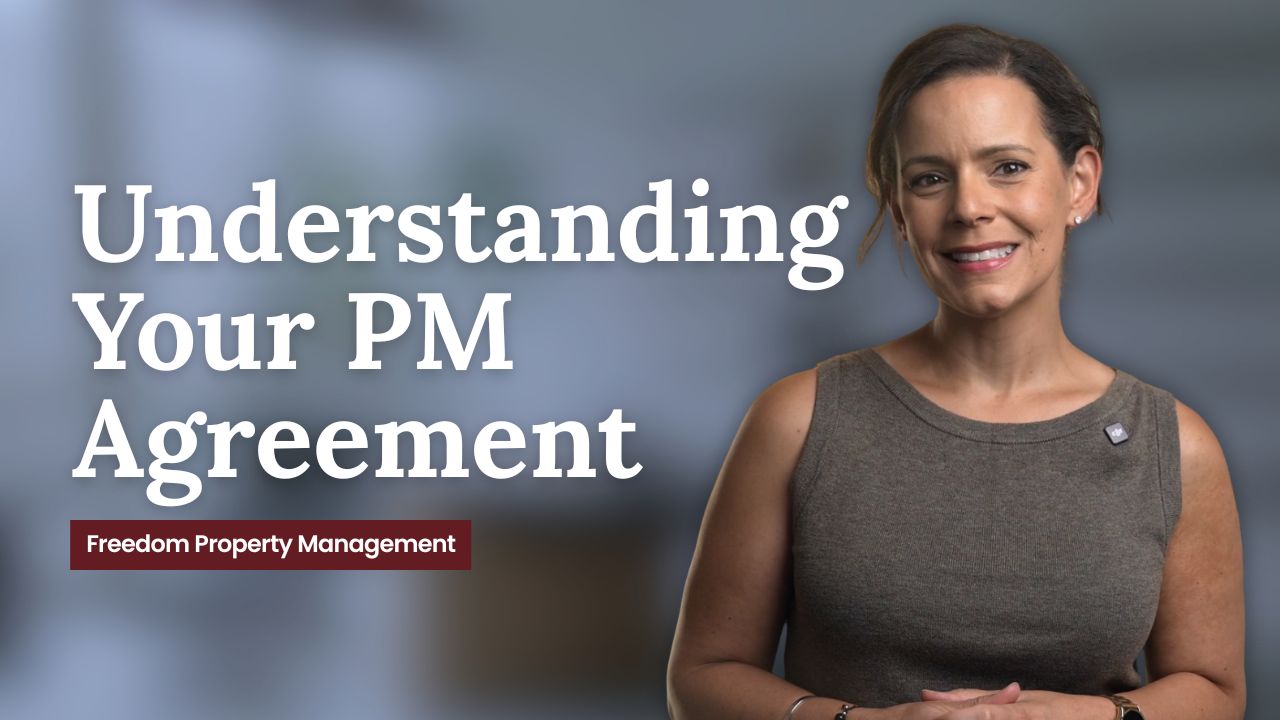
At Freedom Property Management & Sales, we recently created a nine-part video series with our Principal Broker and Owner, Tiffany Izenour, to help landlords better understand what goes into a professional property management relationship.
Rather than reading a contract line by line, our Understanding Your Property Management Agreement video series on YouTube explains what these provisions mean in real-world property management.
Below, we break down nine of the most important areas every landlord should understand when evaluating a Property Management Agreement or choosing a property management company.
1. A Property Management Agreement Should Clearly Define Who Handles What
One of the biggest reasons property management relationships become frustrating is not necessarily because someone made a major mistake.
Often, the problem is that expectations were never clearly established in the first place.
A Property Management Agreement should define the authority being given to the management company, the responsibilities that remain with the landlord, and how common situations will be handled.
Professional property management can include:
Marketing and advertising the rental property
Coordinating showings
Screening rental applicants
Preparing and executing leases
Collecting rent and other authorized charges
Holding and accounting for security deposits
Coordinating maintenance and vendors
Conducting property inspections
Handling tenant communication
Managing lease violations and notices
Maintaining financial records
Monitoring legal and regulatory compliance
Coordinating lease renewals and move-outs
The purpose of giving a property manager this authority is not to remove the landlord from major decisions about the investment.
It is to allow the management company to handle routine operational decisions without requiring the owner to approve every email, repair appointment, notice, or administrative task.
Otherwise, professional management quickly becomes inefficient for everyone involved.
In the first episode of our series, Tiffany explains why we view the Property Management Agreement as the roadmap for the relationship between Freedom and the landlords we serve.
The goal is not simply to understand the legal language. It is to understand why each provision exists, what problem it is designed to prevent, and how it helps the property manager effectively manage the rental property.
2. Look Beyond the Management Fee: What Protections Does the Company Stand Behind?
When landlords compare property management companies, one of the first questions is often:
“How much do you charge?”
That is certainly an important question, but it should not be the only one.
Another useful question is:
What happens when things do not go according to plan?
Rental properties involve people, homes, financial obligations, weather, maintenance, changing markets, and occasionally unexpected circumstances. No property manager can eliminate every risk involved in owning rental real estate.
What you can evaluate is how the company manages those risks and whether it stands behind its processes.
At Freedom, our Property Management Agreement includes six owner guarantees, subject to their individual terms, requirements, and exclusions:
Vacancy Guarantee
Tenant Replacement Guarantee
Management Fee Guarantee
Eviction Guarantee
Pet Damage Guarantee
Satisfaction Guarantee
These guarantees are not a promise that owning rental property will be risk-free.
Instead, they are designed to align our interests with those of our landlords and demonstrate that we are willing to stand behind the systems and services we provide.
For example, our regular management fee is tied to rent actually collected. If rent is not collected, Freedom does not collect its regular management fee.
Our tenant replacement, eviction, pet damage, and vacancy guarantees address other situations that landlords commonly worry about when placing a rental property into professional management.
The specific eligibility requirements matter, so landlords should always review the actual agreement rather than assuming a guarantee applies to every situation.
Watch Episode 2: Guarantees That Protect Your Investment
Episode 2 explains all six Freedom guarantees, why they exist, and how they fit into our larger approach to managing risk.
3. What Does a Property Manager Actually Do Every Day?
One of the most common misconceptions about professional property management is that the job mainly consists of collecting rent and calling a contractor when something breaks.
In reality, much of professional property management happens quietly behind the scenes.
A property manager may make hundreds of routine decisions throughout a tenancy involving leasing, tenant communication, accounting, maintenance, compliance, documentation, and enforcement.
Marketing and Leasing
Finding the right tenant starts before an application is ever submitted.
Depending on the property and market, professional leasing may involve:
Determining an appropriate market rent
Professional photography and video
Advertising the property
Coordinating showings
Working with other real estate professionals
Reviewing rental applications
Verifying applicant documentation
Preparing and executing the lease
Coordinating the move-in process
Pricing is especially important.
Every landlord understandably wants to maximize rental income, but the market ultimately determines what renters are willing to pay. An experienced property manager should help owners balance rental rate, market conditions, property condition, and the financial cost of prolonged vacancy.
Tenant Screening
Applicant screening is another area where consistency matters.
Rather than deciding whether someone “seems like a good tenant,” professional property management should rely on established screening criteria applied consistently and in accordance with applicable law.
Freedom's screening process considers factors such as income, credit, rental history, and other legally permitted criteria.
Consistency is especially important because housing decisions also involve Fair Housing requirements.
Federal, state, and local Fair Housing laws can affect advertising, applicant screening, reasonable accommodation requests, assistance animals, lease enforcement, renewals, and many other stages of the rental relationship.
Landlords interested in the federal Fair Housing requirements can review guidance published by the U.S. Department of Housing and Urban Development (HUD).
Accounting and Rent Collection
Professional management also involves much more financial administration than simply depositing a rent payment.
A management company may be responsible for:
Rent collection
Late charges authorized by the lease
Security deposit accounting
Vendor payments
Owner statements
Income and expense reporting
Owner distributions
Year-end financial documentation
Freedom landlords can access financial information and other property documentation through their Owner Portal, and our Owner FAQs answer many common questions about distributions, leases, security deposits, reports, and the management process.
Watch Episode 3: How We Manage Your Property Every Day
Episode 3 provides a behind-the-scenes look at the leasing, screening, compliance, accounting, and management responsibilities Freedom handles for our landlords.
4. Your Agreement Should Explain How Maintenance, Repairs, Inspections, and Emergencies Are Handled
Maintenance is one of the areas where clearly defined authority matters most.
Consider a few common scenarios:
A tenant reports that the HVAC system stopped working during a Virginia summer.
A slow plumbing leak is discovered.
Water begins coming through the ceiling late at night.
A routine repair is needed that costs a few hundred dollars.
Would you want your property manager to wait hours, or potentially days, for permission before responding to every situation?
Probably not.
At the same time, most landlords understandably do not want a management company approving an unlimited amount of work without involving them.
A good Property Management Agreement should establish the balance.
Routine Maintenance Approval
Freedom's current Property Management Agreement states that we make every effort to stay within the individual repair approval amount established in the agreement, currently $500 for ordinary repairs, except in emergencies.
That authority allows many routine issues to be addressed promptly without creating unnecessary delays for the tenant or allowing a small maintenance problem to become more serious.
If a repair turns out to be larger than expected, the landlord can then be brought into the decision-making process.
Emergency Maintenance
Emergencies are different.
A burst pipe, serious electrical problem, active water intrusion, or other situation threatening the property, safety, or habitability may require immediate action.
In those situations, a property manager needs enough authority to take reasonable steps to mitigate the problem first and communicate with the landlord as soon as practical.
The alternative could be significantly greater property damage while everyone waits for an approval email.
Property Inspections
Inspections are another important part of protecting a rental investment.
Depending on the property and management agreement, these can include:
- Move-In Inspections
Documenting the property's condition before the tenant takes possession provides an important baseline for the tenancy. - Periodic Inspections
These can help identify maintenance concerns, lease issues, safety items, or preventive maintenance opportunities before they become larger problems. - Move-Out Inspections
A detailed inspection at the end of the tenancy helps identify turnover work, property maintenance needs, and potential tenant-caused damage. - Vacant Property Checks
Properties may still require attention while vacant, including security, utilities, landscaping, filters, and maintenance monitoring. - Preventive maintenance may not be as noticeable as responding to an emergency, but catching a small issue early can often prevent a much larger expense later.
Using Qualified Contractors
Another important question is who performs repairs.
Freedom works with qualified, licensed, and insured contractors and requires maintenance during an occupied tenancy to be handled through the management process in accordance with our agreement.
There are good reasons for this.
Once a tenant occupies the property, maintenance can involve notice requirements, access, scheduling, documentation, liability, licensing, permitting, and tenant communication.
It is no longer simply a matter of fixing something around your own house on a Saturday afternoon.
Watch Episode 4: Maintenance, Repairs & Emergencies
Episode 4 goes deeper into inspections, preventive maintenance, contractors, repair authorization, safety compliance, and how Freedom responds when an emergency cannot wait.
5. Understand Property Management Fees by Understanding the Work Behind Them
When comparing property management companies, landlords frequently compare monthly percentages.
But two companies can charge similar management fees while providing very different services.
One may include inspections, guarantees, compliance systems, proactive communication, and extensive leasing support.
Another may provide a much narrower service.
That is why landlords should evaluate the complete management relationship, not simply one percentage.
Freedom's standard Property Management Agreement currently provides for a monthly management fee of $150 or 8% of gross rent collected, whichever is greater, unless different terms apply to a particular agreement.
That ongoing management fee supports responsibilities throughout the tenancy, including:
Tenant communication
Accounting
Rent monitoring
Maintenance coordination
Lease administration
Documentation
Compliance
Owner communication
Day-to-day property oversight
There are also certain points in the rental property's lifecycle that require significantly more work.
Leasing Fees
Placing a new tenant can involve photography, marketing, showings, inquiries, screening, documentation review, lease preparation, inspections, and move-in coordination.
Lease Renewal Fees
A lease renewal is not simply changing the dates on the previous lease.
The process may begin months before expiration and include evaluating market rent, discussing renewal strategy, negotiating with the tenant, preparing documents, obtaining signatures, and updating the property's records.
A successful renewal may also save the landlord considerably more than the cost of the renewal by avoiding vacancy and turnover expenses.
Other Situational Fees
A Property Management Agreement may also provide for fees that only apply in less common situations, such as:
Taking over an occupied property
Coordinating a major insurance or restoration project
Managing certain recurring owner bills
Coordinating a home warranty claim
Providing services outside normal management
Facilitating certain property or document transitions
Most landlords may never encounter many of these charges.
The important thing is that they are disclosed and understood before the situation occurs.
Watch Episode 5: Understanding Fees & Compensation
Episode 5 explains Freedom's management, leasing, renewal, project-management, and situational fees and, more importantly, what work each fee supports.
6. What Responsibilities Still Belong to the Landlord?
Hiring a property manager should remove much of the day-to-day work of being a landlord.
It does not eliminate the responsibilities that come with owning the property.
Professional management works best when the Property Management Agreement clearly separates the property manager's responsibilities from the owner's.
Some important landlord responsibilities include:
Maintaining Appropriate Insurance
Rental properties need appropriate insurance protection.
Landlords should make sure their insurance carrier knows the property is being used as a rental and review coverage with an insurance professional.
Coverage for lost rental income may also be important if a covered event makes the property temporarily uninhabitable.
If a property becomes vacant, owners should notify their insurance company because vacancy can affect policy requirements and coverage.
Keeping the Property Properly Funded
Rental properties occasionally need repairs.
Maintaining the reserve required under the management agreement gives the property manager the ability to respond to routine needs instead of delaying work while waiting for money to be transferred.
Think of the reserve as a readiness fund for your rental property.
Preparing the Property for Leasing
Every additional day a home is not rent-ready can mean another day it cannot effectively compete for a qualified tenant.
Owners need to complete agreed-upon responsibilities, remove personal property, and make the home available according to the planned leasing timeline.
Keeping Information Current
Owners should tell their management company when relevant information changes, including:
Email address
Phone number
Mailing address
Banking information
Insurance coverage
Property ownership
Other circumstances affecting the property
Good communication needs to work in both directions.
Making Ownership-Level Decisions
The landlord still owns the investment.
A property manager handles operations, but larger decisions about the asset still belong to the owner.
Watch Episode 6: Your Responsibilities as a Property Owner
Episode 6 explains the other side of the management relationship and why good property management should function as a partnership.
7. What Happens If You Want to Change or End Property Management?
Most property-management relationships are intended to last for years.
But circumstances change.
A landlord may sell the property, move back into it, change investment strategies, or decide a particular management company is no longer the right fit.
Likewise, circumstances may arise where a property manager determines that it can no longer effectively manage a property.
A professional agreement should explain this before either party needs to use the provision.
Important areas to review include:
Length of the initial agreement
Renewal provisions
Notice requirements
Owner termination rights
Management-company termination rights
Fees associated with termination, if any
Transfer of records and funds
Handling of an existing tenancy
What happens if the property is sold
What happens if financial circumstances such as foreclosure affect the rental
Freedom's agreement continues on a month-to-month basis following its initial term unless ended in accordance with the agreement.
It also includes a Satisfaction Guarantee because our philosophy is that a landlord should continue working with Freedom because the relationship is working, not simply because leaving is intentionally difficult.
The agreement also allows certain policies and procedures to evolve through written notice.
That matters in property management because laws change, technology changes, industry standards evolve, and the way rental properties need to be managed changes along with them.
Virginia landlords can review the current Virginia Residential Landlord and Tenant Act (VRLTA) through the official Code of Virginia.
We also regularly publish updates for landlords when important legal or market changes occur. Our Northern Virginia Landlord Update covers several recent changes and trends affecting rental property owners.
Watch Episode 7: When Circumstances Change
Episode 7 discusses renewals, termination, policy changes, financial circumstances, and the process for transitioning a management relationship.
8. Do Not Ignore the “Fine Print”
Nobody hires a property manager because they are excited to discuss indemnification, mediation, notices, or dispute resolution.
But these provisions exist for a reason.
A good agreement does not only explain what happens during an ordinary month when rent arrives and nothing breaks.
It also establishes a process for unusual situations.
Liability and Ownership
A property manager acts as the landlord's authorized agent, but the management company does not become the owner of the real estate.
Certain legal and financial responsibilities will always remain with the property owner.
Landlords with questions about specific legal provisions should have an attorney review the agreement.
Resolving Disagreements
Freedom's agreement generally provides for non-binding mediation before litigation if a significant dispute arises.
The idea is straightforward: when possible, understand the disagreement, communicate, and attempt to reach a practical solution before escalating to more expensive legal proceedings.
Official Communication
Property management agreements may also establish how official notices are delivered.
That is another reason landlords need to maintain current email addresses and contact information.
Wire Fraud
Real estate transactions and property ownership can also be targets for wire fraud.
If you ever receive unexpected or changed wiring instructions that appear to come from your property manager, attorney, title company, lender, or another real estate professional, do not automatically rely on the information in that message.
Independently contact the company using contact information you already know and trust before transferring funds.
Watch Episode 8: Protecting the Relationship
Episode 8 discusses liability, dispute resolution, official communications, electronic signatures, wire fraud, and other safeguards that help protect the management relationship.
9. The Contract Matters, but the Relationship Matters More
A Property Management Agreement can define responsibilities.
It can establish authority.
It can outline fees.
It can establish processes.
What it cannot create by itself is trust.
That part has to be earned.
When you hire a property management company, you are trusting that company to represent you, communicate with your tenants, make day-to-day decisions, manage problems, and help protect what may be one of your most valuable assets.
Landlords should expect professional property management to include more than transactions.
Communication When It Matters
Property owners should be appropriately informed without having to live inside every daily detail of managing the rental.
That does not necessarily mean receiving unnecessary updates every day.
Sometimes not hearing much means the tenancy is simply operating as expected.
But when something important happens, landlords should expect timely, professional, and candid communication.
Good Tenant Service Is Good Landlord Service
Providing good service to tenants and protecting a landlord's interests should not be competing goals.
Tenants who receive clear communication, reasonable expectations, professional maintenance coordination, and respectful treatment are better positioned to have successful tenancies.
And successful tenancies benefit landlords.
Proactive Management
Strong property management is often about keeping small problems small.
That includes preventive maintenance, inspections, consistent screening, documentation, compliance systems, and dealing with concerns before they become larger and more expensive.
Continuing Education
Virginia landlord-tenant laws continue to evolve.
So do Fair Housing requirements, technology, rental-market conditions, security threats, and industry best practices.
A professional management company should continually review and improve its systems rather than relying exclusively on how things were done years ago.
At Freedom, our team invests in continuing education, professional associations, industry events, technology, and internal training so our management practices can continue to evolve along with the rental industry.
Watch Episode 9: What You Can Expect From Freedom
In the final episode, Tiffany steps away from the legal language and explains what Freedom believes landlords should expect from a long-term property management partner.
How to Evaluate a Property Management Agreement Before You Sign
If you are comparing property managers in Northern Virginia, do not evaluate the agreement based on the monthly management fee alone.
Before signing, make sure you understand:
What authority you are giving the management company
How applicants will be screened
Who signs and manages the lease
How Fair Housing compliance is handled
How rent and security deposits are managed
How maintenance approval works
Who can authorize emergency repairs
What inspections are performed
Which contractors can work on the property
What financial reserves you must maintain
What insurance coverage you are expected to carry
Every recurring and situational fee
What guarantees are included and their eligibility requirements
How communication and notices are handled
How either party can end the management relationship
What responsibilities remain with you as the landlord
A Property Management Agreement should not leave you guessing about how your property will actually be managed.
The best time to clarify expectations is before a difficult repair, tenant issue, payment problem, or disagreement occurs.
Frequently Asked Questions About Property Management Agreements
What is a Property Management Agreement?
A Property Management Agreement is a contract between a property owner and a property management company. It defines the services the property manager will provide, the authority the owner gives the manager, the fees and compensation involved, the owner's responsibilities, and the rules governing the management relationship.
For rental properties, it may address leasing, tenant screening, rent collection, maintenance, inspections, accounting, financial reporting, communication, termination, and other management responsibilities.
What should I look for in a property management contract?
Landlords should understand the company's management authority, leasing and screening process, maintenance procedures, repair approval limits, inspection practices, financial controls, fees, insurance requirements, termination provisions, and the responsibilities that remain with the property owner.
Do not focus solely on the monthly management percentage. Compare the actual services, systems, protections, communication, and level of oversight included.
Can a property manager sign a lease for the landlord?
A property manager may be authorized under a Property Management Agreement to prepare and execute rental agreements as the landlord's agent.
At Freedom, our Property Management Agreement authorizes us to prepare and execute leases on behalf of the landlord while owners retain access to their lease documents.
Who decides whether a rental applicant is approved?
Professional management companies should use established rental criteria and apply them consistently in accordance with applicable Fair Housing and landlord-tenant laws.
Freedom evaluates applicants according to our Tenant Selection Criteria, including factors such as income, credit, rental history, and other legally permitted screening criteria.
Does a property manager need landlord approval for every repair?
Not necessarily.
A Property Management Agreement commonly gives the manager authority to approve routine repairs up to an established amount so maintenance is not unnecessarily delayed.
Freedom's current agreement provides that we make every effort to stay within a $500 individual approval amount for ordinary repairs. Emergencies may require immediate action to protect the tenant, the property, or habitability.
Landlords should review their individual agreement for the terms that apply to them.
What responsibilities does a landlord still have after hiring a property manager?
Even with full-service professional management, the landlord remains the property owner.
Responsibilities may include maintaining appropriate insurance, keeping the property properly funded, maintaining required reserves, providing accurate information, preparing the property for leasing, keeping contact and ownership information current, and making larger investment-level decisions.
How much does property management cost in Northern Virginia?
Property management pricing varies significantly depending on the company, property, services, and agreement.
Freedom's standard current agreement provides for a management fee of $150 per month or 8% of gross rent collected, whichever is greater, although individual agreements may differ.
Landlords should also ask about leasing fees, renewal fees, inspection costs, project-management charges, and other situational fees rather than comparing only the monthly percentage.
Can I end a property management agreement?
That depends on the termination provisions in your contract.
Property owners should review the required notice, initial contract term, renewal structure, termination rights, potential fees, and transition process before signing.
Freedom's agreement also includes a Satisfaction Guarantee designed to provide landlords with a defined path to end the management relationship, subject to the terms of the agreement.
Why is a Property Management Agreement important?
The agreement creates clear expectations before a problem occurs.
It gives the property manager the authority needed to operate efficiently while defining limits, responsibilities, financial obligations, communication procedures, and what happens when unusual situations arise.
For both landlords and property managers, clarity at the beginning can prevent confusion later.
Looking for Property Management in Northern Virginia?
If you own a rental property in Manassas, Prince William County, Fairfax, Loudoun, Stafford, or elsewhere in Northern Virginia, choosing a property manager should involve more than comparing fees.
Ask how the company handles screening.
Ask how repairs and emergencies are managed.
Ask what happens behind the scenes during a tenancy.
Ask how the company stays current with Virginia landlord-tenant laws and Fair Housing requirements.
And most importantly, make sure you understand the agreement that will govern the relationship.
Freedom Property Management & Sales has been serving rental property owners in Northern Virginia for more than 20 years. Our team handles leasing, tenant management, maintenance coordination, inspections, accounting, compliance, and the day-to-day responsibilities that come with owning a rental property.
You can learn more about Freedom Property Management & Sales, explore our Owner FAQs, or contact our team to discuss your rental property.
And if you want a deeper look at how we manage properties before making a decision, watch all nine episodes of our Understanding Your Property Management Agreement video series.
This article and the Understanding Your Property Management Agreement video series are intended to explain property management concepts and Freedom's management practices in general terms. They are not legal, tax, or insurance advice. Individual agreements and circumstances may vary. Property owners should review their own Property Management Agreement and consult the appropriate legal, tax, insurance, or other professional adviser when needed.